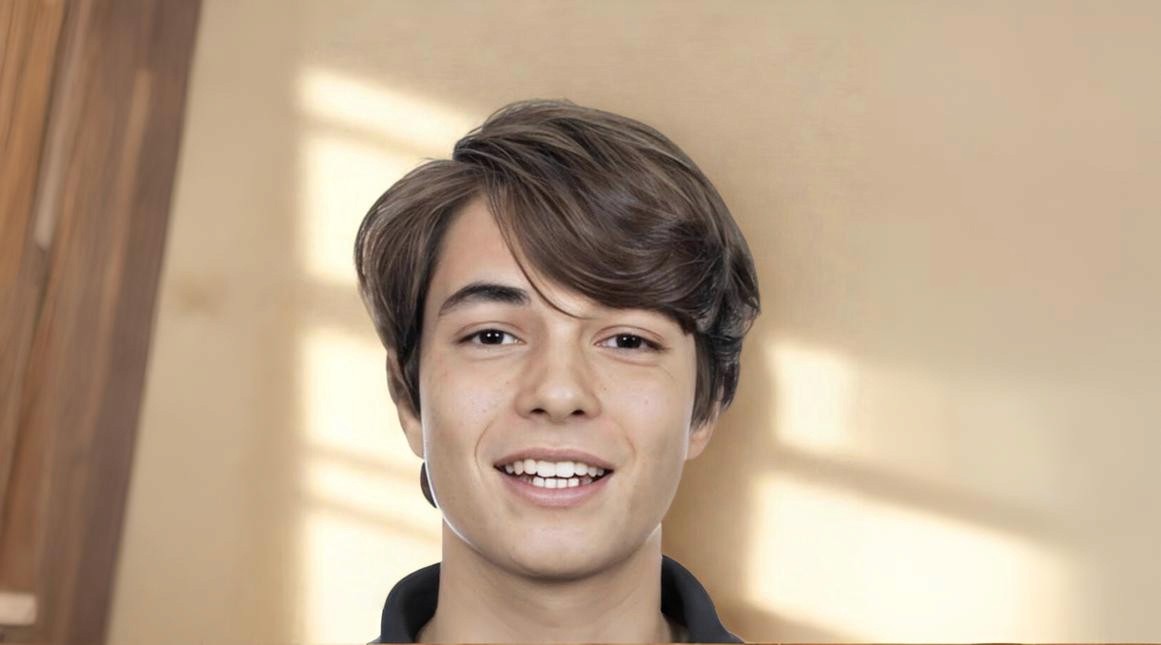
Luca Meyerhans is a high school student from Spain with a strong passion for physics and mathematics. He is deeply committed to expanding access to education and founded Mathematics for Everyone, an organization that offers free math lessons, especially for students with learning disabilities. He also serves as the deputy prefect of the Wellbeing Department at his school, promoting acceptance and inclusion, and volunteers with AFDACAT (the Catalonian dyslexia organization), helping improve academic accommodations for dyslexic students in Barcelona.
Luca participated in both the Summit STEM Fellowship (SSF) and Summit Research Scholars (SRS) in 2025. Through SSF, Luca grew Mathematics for Everyone and expanded it internationally across multiple countries, and through SRS, he pursued a research project that combined his interests in astrophysics and cosmology. Read on to learn more about Luca, his journey in STEM, and his aspirations for the future!
Meet Luca!
How did you initially become interested in STEM?
I always felt that my path was limited due to my dyslexia, which made me feel like I had to pursue STEM. At the beginning, I didn't like STEM because I felt it was more of an obligation than something I had to be passionate about. It wasn't a passion of mine until I encountered a physics question I couldn't solve. I found myself thinking, "What's happening? Why can't I solve this? Is there something I'm missing?" So, I started investigating and doing some research until I found the solution. I was really happy when I finally answered it, and that motivated me to look for more difficult topics!
What academic subjects or fields of STEM are you most interested in?
I'm most interested in physics and math because they're quite logical, and that's what I like. In languages, I cannot control what I write or read, but in STEM, everything is so predictable, and it feels like home. Once you understand the terms of what you're doing, being able to manipulate an equation or change the subject of it just becomes second nature.
What extracurricular activities are you involved in?
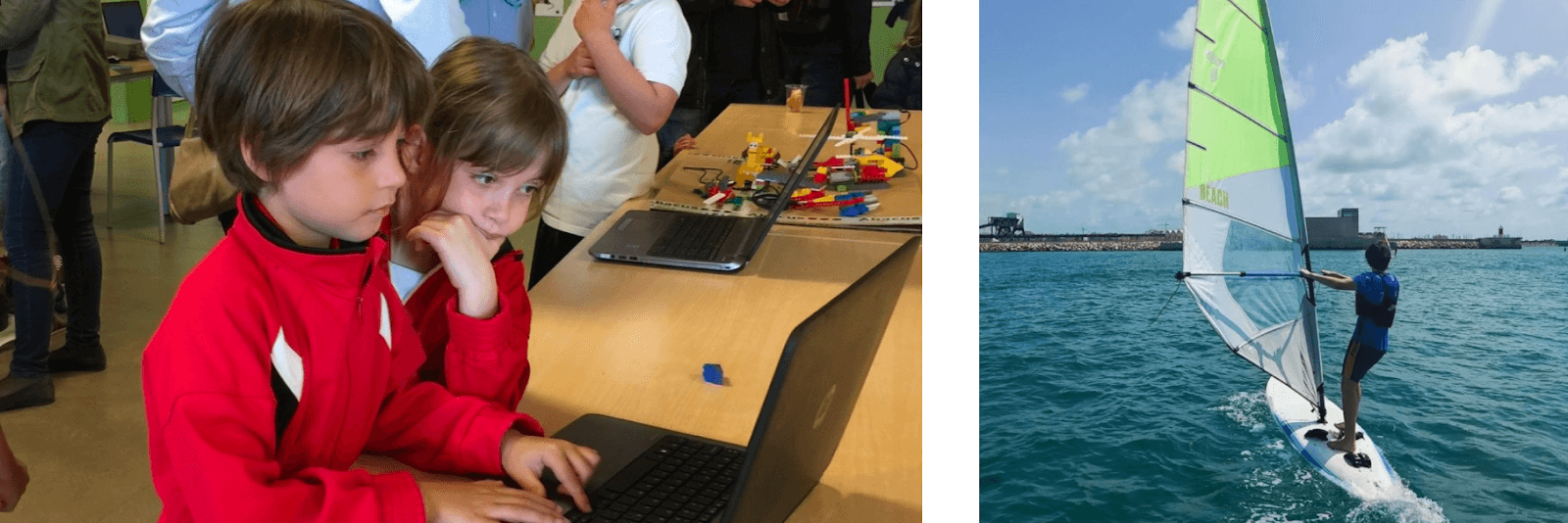
I do programming, and have been self-studying to prepare for the Physics Olympiad. I'm the deputy prefect of the Wellbeing Department at my school, where I work to promote acceptance of diversity. I'm also a volunteer at AFDACAT, the Catalonian dyslexia organization, where I'm leading a program to change adaptations for dyslexic individuals in Barcelona, and I hope to expand it throughout Spain.
Outside of academics, I like to hang out with friends, and I’m quite close with my sister. I also enjoy windsurfing a lot; I find it quite relaxing. From time to time, I also make kites!
Summit STEM Fellowship Experience
What was your favorite part about the Summit STEM Fellowship?
My favorite part was that I had the chance to meet and get to know so many people, like fellow peers, the peer ambassadors, and mentors. Meeting the mentors during the Office Hours was really nice because it felt more like a family connection rather than a formal mentor-mentee relationship. Office hours were definitely my favorite part of the program, and I have really good memories of a meeting with all of the mentors and my peers! It was nice to find common interests with people from all over the world that I would never have met before if not for the Fellowship. Also, everyone in the community is so helpful and shares so much information with each other. I was really surprised to see so many people starting initiatives to help others after being inspired during the fellowship!
Which speaker or session resonated with you the most during the fellowship?
I really enjoyed learning from Isabella Delbakhsh, Sirja Joeveer, and Elena Klopfenstein during their Fireside Chats and speaking with them one-on-one during Office Hours. Isabella, in particular, spoke during her Fireside Chat about writing a book and getting published while still in high school. I was so inspired, and I thought it would be great to show her the book I wrote to get her feedback. She really encouraged me to take the final steps towards publishing, which I’m currently pursuing. She also goes to Stanford, which is my dream school!
Ben Zhang’s Fireside Chat on perseverance and the commitment to study one hour a day also especially resonated with me. I took that to heart, and now I study one hour a day, mostly in physics, because I enjoy it the most!
What advice would you give to future Summit STEM fellows?
Don’t compare yourself to others and always believe in yourself. We talked a lot about that during the fellowship. It's important to be relaxed and open to new experiences, to take risks, and not just get stuck in the planning process. Focus on what you’re passionate about. I struggled to find my community at first, but once I embraced my dyslexia, I felt empowered to help others have a better experience.
Summit Research Scholars Experience
What was your favorite part about the Summit Research Scholars Program?
I loved the technical lessons. They were important foundations and genuinely fun! Even though the program was fast-paced and intense, you learn an incredible amount in a short time. The session on using Pandas and Python stood out to me, especially because I’m continuing the research I proposed during SRS and working with large datasets, so that lesson has been extremely helpful in that. Before SRS, I thought research was mostly about finding results, but I also learned how important it is to present your findings well. That’s something I hadn’t really thought about before, especially in school projects. If I compete in things like ISEF, I would never have thought about structuring everything so cleanly without this experience.
Can you describe your research topic and why you chose to explore it?
My research combines astrophysics and cosmology. I’m studying metallicity, specifically the amount of iron in space, and how it affects the physical properties of white dwarfs. I’ve always been fascinated by cosmology and how the universe works. While learning about stellar evolution, I became interested in white dwarfs, and I also wanted to incorporate chemistry, since iron plays a key role in star collapse. This project allowed me to combine my interests in both physics and chemistry in my research.
How has SRS changed the way you think about research?
I didn’t really understand what research looked like for a student, and I had trouble finding a realistic research question. My peers were diving into some very niche projects I had never considered before. It opened my eyes to all the possibilities, and you could feel the excitement! The program was so interactive between the mentors and students; it made the experience much more engaging. SRS helped me figure out how to work with data to compose a well-presented research topic that could be niche, while still feeling meaningful.
Future Aspirations
What are your goals over the next few years, and what type of career are you hoping to pursue?
I have some big goals! First, I want to win the Gold Medal at the Physics Olympiad. My motto is, "If you can dream it, there’s no cost to dreaming." After that, I aim to graduate from Stanford with a double degree in math and physics, or possibly a triple degree in math, physics, and aerospace engineering. After graduating, I first plan to pursue a master's degree in physics, then a PhD, focusing on dark matter and energy or relativity. Ultimately, I’d like to become a university professor!
Have you been working on any exciting projects after the Fellowship ended?
During the summer, we talked a lot about the benefits of cold emailing to create new opportunities for yourself. I was really inspired, so I contacted Dr. Jeremy, a Harvard professor who researches cell memory, and I asked if I could work on a research project with him. We plan to do the research at UPF University, and we’re still working out the details, but I’m so excited!
I also founded an organization called Mathematics for Everyone, which is currently multinational thanks to Summit. Through that, we provide free math lessons and teach others. The objective is to help others, especially since dyslexia has impacted me a lot. It taught me different ways to learn, and I discovered that visual learning works best for me, so I try to find ways for everyone to learn effectively. Additionally, I was inspired during the programs to write a book influenced by my experiences with dyslexia, and it was recently published!
How have the Summit Education programs influenced your career aspirations?
There was a mentor at SSF who was obsessed with magnets, Isabel Duran, and her deep passion actually made me want to learn more about magnetism, even though I wasn't really interested in it before. Her excitement was so contagious, and it only made me more excited about college and all of the learning possibilities!
Also, right now, I want to become a cosmologist, and SRS helped me understand what research in that field could realistically look like at this stage. Both programs broadened my perspective on what’s possible in college and beyond. Seeing mentors with such deep passion for their fields motivated me to explore new topics and stay curious!